

Ann Cleare, Sketch for on magnetic fields, 2011

Jan-Müller Wieland, 2023.

Mark Andre, Score excerpt and sonography for über, for electronics and orchestra, 2015.

Márton Illés, Sketch for Psychogramm VII „Perlekedős“ (zankend) for guitar, 2022.

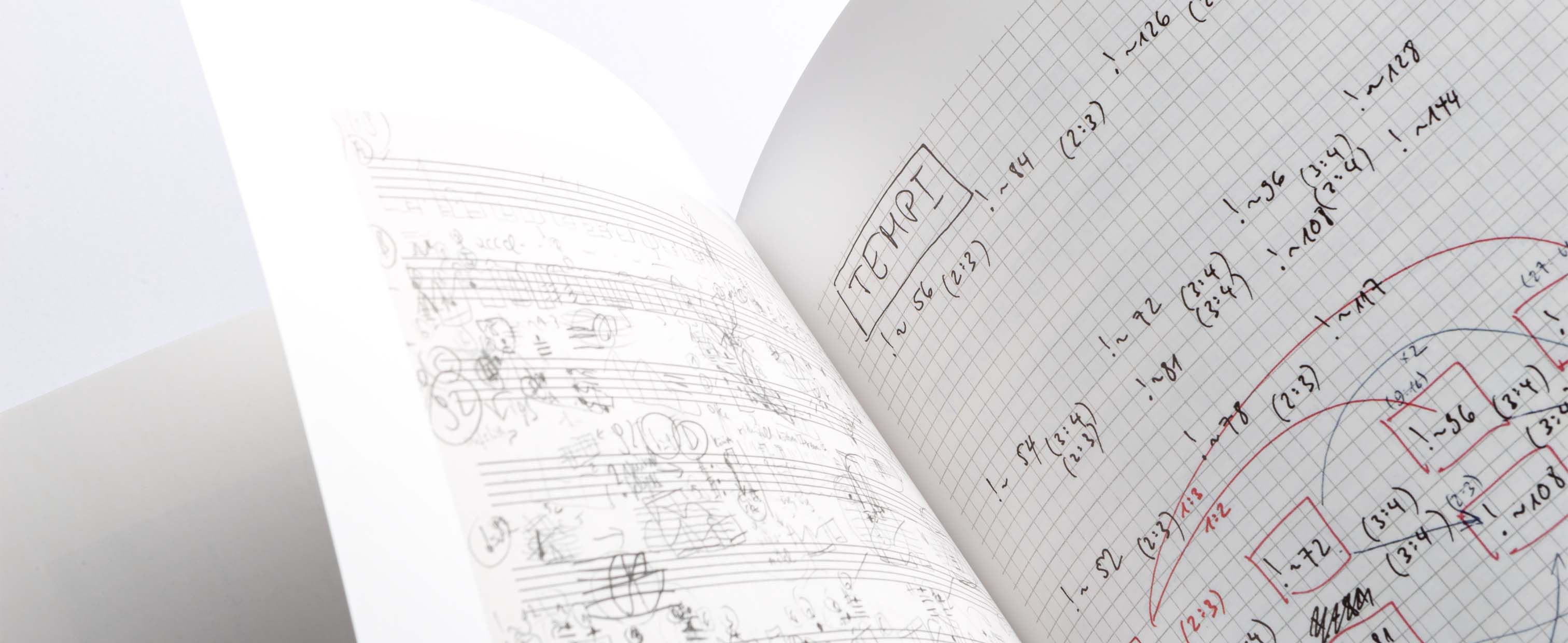
David Philip Hefti, Tempo sketch for Die Schneekönigin, 2018.

Markus Hechtle, Sketch for Minotaurus for speaker and ensemble with the same-titled text by Friedrich Dürrenmatt, 2012.

Eric Wubbels, Sketch for INSTRUMENTS, 2022.

Pierluigi Billone, Sketch for Kosmoi. Fragments, 2008
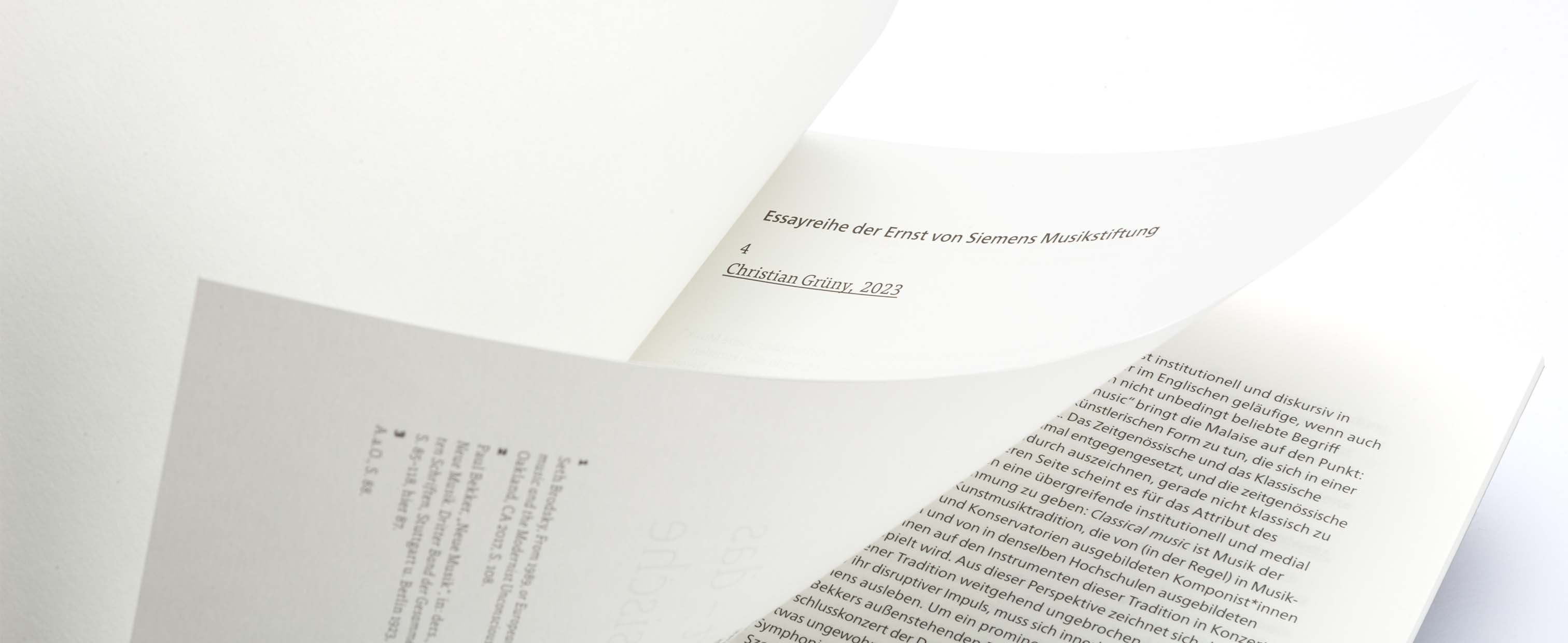
Ernst von Siemens Music Foundation Essay Series
Christian Grüny, 2023 Fiendishly Complicated Ways – the New, the Contemporary, and Music
“New Music” is nervous. Starting with its orthography: why this anxious “N” and “M”? – Seth Brodsky 1 Seth Brodsky, From 1989, or European music and the Modernist Unconscious, Oakland; CA 2017, p. 108.
Paul Bekker begins his famous 1919 lecture on Neue Musik with an alarming observation: in all artistic areas there is progress with “very remarkable new developments in terms of the style and direction of artistic creation”
2
Paul Bekker, „Neue Musik“, in: ders., Neue Musik. Dritter Band der Gesammelten Schriften, Stuttgart u. Berlin 1923, pp. 85–118, here p. 87.
at every turn, “only in music one notices little or almost nothing of this direct, shared experience of the present, and the outside observer easily comes to the conclusion that there is nothing new in musical production, in an objectively serious sense”.
3
loc. cit., p. 88.
Actually, Bekker contends, the reality is quite different: he does find contemporary developments capable of competing with those in visual art, architecture, literature and theatre, only they have not yet entered the general public’s consciousness in the same way and are largely ignored by the music industry.
This observation can easily be applied to the present situation, although architecture and literature now only belong to the same discursive field to a limited extent: in terms of links with contemporary discourses and developments, there seems to be a clear disparity between, on the one hand, visual art and some areas of the performing arts and, on the other hand, music. In the field of the arts, visual art is in a position of uncontested hegemony – it determines the discourses, it enjoys the greatest public awareness, it acts as a reference for the other art forms. That New Music, by contrast, appears to be isolated and marginalized would be tolerable if it were generally undisputed that it is keeping up with the times (and were there agreement about what that means exactly). But this is not really the case. However, and this also connects us with Bekker’s time, it is not entirely true either, because of course today there is a wide spectrum of musical and music-related positions that are very clearly aware of the developments in other artistic fields and of social reality.
And yet: institutionally and discursively New Music is in a precarious position. The term “contemporary classical music”, which is commonly used in English despite not necessarily being popular among its protagonists, sums up the malaise: we are dealing with an art form we are dealing with an art form that finds itself in a paradoxical situation.that finds itself in a paradoxical situation. For a start, the contemporary and the classical are in opposition to one another, and contemporary music is meant to distinguish itself precisely by being not classical. For another thing, there also seems to be an overarching definition of the attribute “classical” influenced by institutions and the media: classical music is music in the European art music tradition, which is (generally) written by composers educated at music universities and conservatoires, and which is performed in concert halls on this tradition’s instruments by musicians educated at the same institutions. From this perspective, New Music is almost invariably inscribed in that tradition,Classical music and its newness, its disruptive impulse, must express itself within the traditional framework. To give a prominent example: to Bekker’s outside observer, any final concert at the Donaueschinger Musiktage might seem like a perhaps rather unusual sounding but otherwise perfectly normal symphony concert. Not surprisingly, many people, even in the New Music scene itself, would not want to have anything to do with it – were it not for the cultural and financial capital promised by a composition commission for this concert. Someone who receives a commission for an orchestra piece writes a piece for orchestra, because it is there and needs to be catered to.
Presumably Bekker did not originally set out to suggest a new terminology with his title, but the term Neu makes it clear that he wanted not only to point out current developments but to emphasize their radicalism. It was natural to fall back on the central category of modernity, which to this day remains pivotal to the specifically German concept of Neue Musik. In one respect, today this term brings the Mexican Institutional Revolutionary Party to mind: a promise of constant upheaval that nobody “shared experience of the present”in any more because it has long since become a kind of brand name. But making fun of it is trite, and not particularly constructive either.
In Bekker, the “shared experience of the present” – that is, the contemporary – is directly coupled with the new. To him, the two appear to be identical. Here everyday language is on his side, but if the two are viewed as theoretically sophisticated concepts, the identification cannot hold. Such reflections inevitably lead to historical-philosophical questions, to which many of the art theory categories are closely linked.
Reinhart Koselleck distinguished between three different concepts of the historically new: a rather unsophisticated one according to which any given present is new, one used “in the sense of completely other, even better than what has gone before”,
4
Reinhart Koselleck, “Neuzeit. Remarks on the Semantics of Modern Concepts of Movement”, in: id., Futures Past. On the Semantics of Historical Time, New York: Columbia University Press 2004, pp. 222–254, here p. 228.
and one that describes a historical period, the Neuzeit. We will see that a very similar and yet not congruent distinction can be made inmodern age relation to the contemporary. The German concept Neuzeit has no exact equivalent in English; the closest is modern age, which itself references the more specific term modernity (die Moderne). Even if we are indisputably still living in the Neuzeit, and a complete restructuring of our understanding both of historymodernity and of ourselves would be necessary for us to be able to conceive of and name a period following this time, there is longstanding controversy about whether modernity has reached its end and what could have taken its place. Art history commonly uses the periodization in which modern art is followed by contemporary art, frequently without any reflection about the historical-philosophical implications. In music, that is not the case.
For our context it is primarily the second meaning that is interesting. However, the new in this sense does not always have to be “wholly other”, and here again it is helpful to distinguish between three variants: divergence, negation and utopia. The new as divergence from the old is obviously the weakest and also the most indeterminate variant, which here nevertheless implies an explicit demarcation. The new in this sense retains its reference to that from which it diverges, which can range from a mere variation to the subversive détournement demanded by the Situationists.
5
Cf. Guy-Ernest Debord & Gil J. Wolman, “Mode d’emploi du détournement”, in: Les lèvres nues 8 (1956), pp. 2–9. Debord later attempted to integrate détournement – rerouting or hijacking – into a dialectic model, which does not really work: cf. Guy Debord, The Society of the Spectacle, New York: Zone Books 1996, pp. 144–146 (Nos. 206–209).
Divergence, in its vagueness, does not appear to be a very productive theoretical concept, but it may be more productive than it seems. I will return to it.
By contrast, in the theoretical reconstruction of real developments in twentieth-century art, the standard model is dialectic negation, following Adorno. This means, with explicit or implicit reference to Hegel, a determinate negation – not going backdivergence, negation and utopiato tabula rasa but referring specifically to the given, or to certain aspects of it, the content of which it retains by negating it. The determinate negation of tonality is therefore not random sounds but the retention of a systematic organization of a limited number of tones without recourse to tonal hierarchies and harmonic logic. The method of negation is polarization, which does not start from a different point and simply ignore what has been created so far but takes it seriously and continues to work on it. Compared with the abstract rejection of what already exists, and also compared with the pathos of extending and developing what has never been heard, which steers clear of historical reflections, it is concrete and is understood as a means of dealing with the present’s actual questions, and as an instrument for the critical continuation of tradition.
The final variant – utopia or radical rupture – goes even further by really evoking the wholly other. It also aspires to be something other than abstract negation because it opts out of the negations game altogether and promises a fundamentally different reality – or, initially, a fundamentally different art – even if negation may initially be the tool it uses. The epitome of this variant is revolution.
6
Gunnar Hindrichs has emphasized the inseparable interweaving of the aesthetic, political and theological dimensions of the motif of revolution. For him the eschatological dimension has the final word (cf. Philosophie der Revolution, Berlin: Suhrkamp 2017).
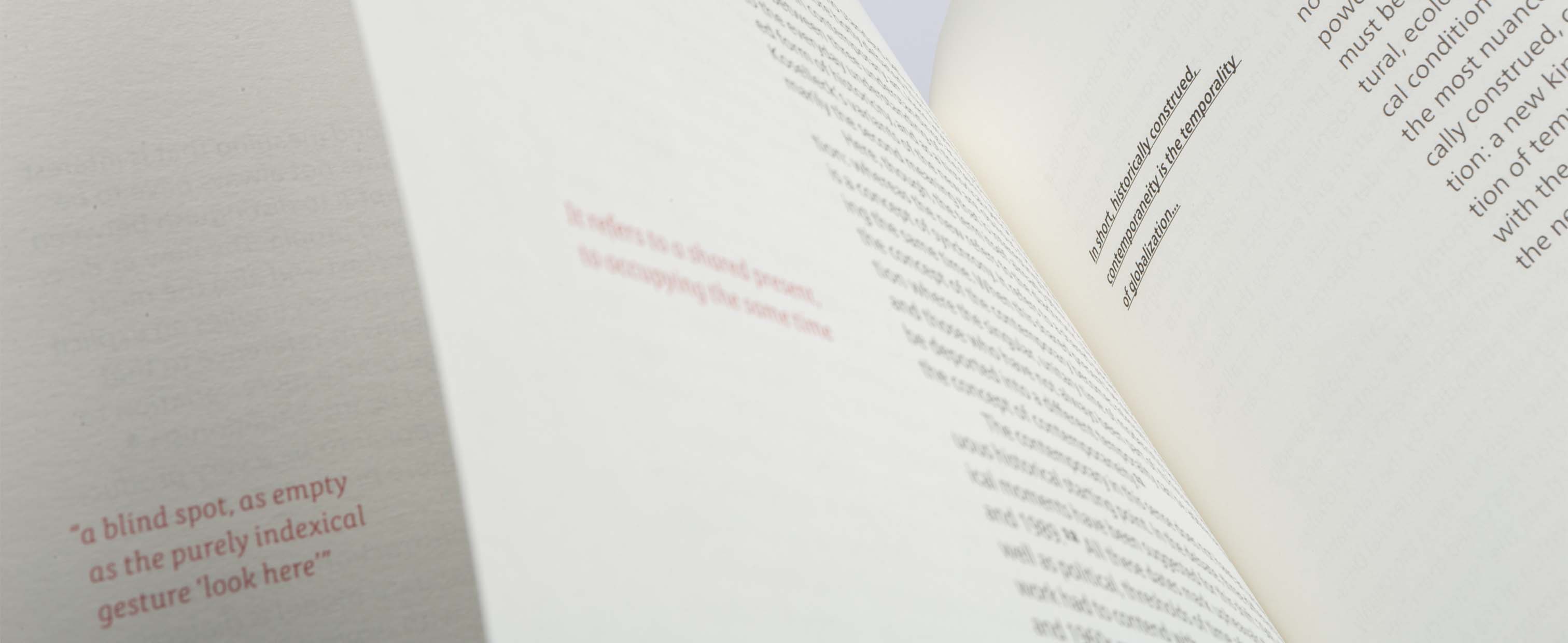
In both politics and aesthetics, such a radical rupture is less a reality than a promise or a threat. Since its beginnings in the aesthetics of Poe and Baudelaire, the new in this sense has oscillated between horror and fascination with the completely different, “a blind spot, as empty as the purely indexical gesture ‘look here’”between classless society and terreur. This new cannot be produced, not even by negating what exists, and in this respect it remains “a blind spot, as empty as the purely indexical gesture ‘this’,
7
Theodor W. Adorno, Aesthetic Theory, London & New York: Continuum 1997, p. 20 (translation modified).
as Adorno puts it. It could be said that without this utopian promise, this empty horizon, criticism becomes an end in itself and the new regresses to mere innovation – but also that generations of artists toil and fail against this impossible horizon. Particularly in New Music, it often leads to an excessively inflated idea of one’s own relevance, which hinders rather than facilitates dealing with the present.
What can we do with it today? Adorno’s central point is that the category of the new, for all its ambivalence – its proximity to fashion and advertising, which as Baudelaire already points out,
8
Cf. Charles Baudelaire, The Painter of Modern Life, London 2010.
are further factors – remains without an alternative. There is no return to an unbroken continuation of tradition, whichever it might be, nor a constantly growing, unresisting reservoir of forms and possibilities to dip into at will. Here the concept of material, which is extremely controversial especially in music, still seems to me to be productive exactly as defined by Adorno. We must remember his starting point, namely the question of how we can think of historicity and continuing development as intrinsic characteristics of works of art without having to draw the absurd conclusion that Schoenberg is “better” than Beethoven. The material of artistic works comes from other artistic works, and using it means responding to it, reflecting on it critically, without this predetermining which direction the result will take. What is to be done each time cannot be established by appealing to “history” and its trends, but it arises through a reflection of the disciplinary,the concept of the new cannot be historicized in the same straightforward way as that of modernity media-related, geopolitical situation of one’s own practice, in which the appropriation of material is embedded. The institutional and discursive conditions of this practice can, or rather should, also be part of this reflection. The result of this work, if it is successful, may continue to be called “new” without linking it to a reductive, fetishistic understanding of “material progress” or continual innovation, against which many people in New Music rightly argue.
9
Cf. in this respect Christian Grüny, “Material und Ort. Rehabilitation einer kritischen Kategorie”, in: Robin Becker, David Hagen & Livia von Samson (eds.), Ästhetik nach Adorno. Positionen zur Gegenwartskunst, Berlin 2022, pp. 49–64.
The concept of New Music is therefore in a rather different situation from that of modern art: the concept of the new cannot be historicized in the same straightforward way as that of modernity. Although it is the signum of modernity, it is not plausible that the new is completely and utterly bound to it, so that the category of the aesthetically new as such would become obsolete.“modernity at large” However, the idea of a unitary history coupled with a corresponding concept of modernity and, above all, the idea of linear progress, have become untenable. A liberal pluralization of forms is not enough here; what is required is a geopolitical revision of the concept of modernity itself that has resulted in notions of “global”, “alternative” or “multiple modernities” or a radically diversified “modernity at large”.
10
Cf. Mike Featherstone, Scott Lash & Roland Robertson (eds.), Global Modernities, London et al. 1995; Dilip P. Gaonkar (ed.), Alternative Modernities, Durham 2001; Shmuel Eisenstadt (ed.), Multiple Modernities, Piscataway 2002; Arjun Appadurai, Modernity At Large. Cultural Dimensions of Globalization, Minneapolis & London 1996.u. London 1996.
This brings us to the sophisticated variant of the concept of the contemporary.
For the contemporary no standard definition can be given either; today it is even more hotly debated than the concept of the new, particularly in contemporary art. Here again it is possible to distinguish between three understandings: as any given present (close to the everyday understanding of the term), as a new, complicated form of historicity, and as a historical period. The parallels with Koselleck’s variants of the new are obvious. Once again it is primarily the second meaning that is interesting for us.
Here, though, the term itself already offers some explanation: whereas the new refers to the diachronic, the contemporary is a concept of synchrony. It refers to a shared present, to occupying the same time. When this shared present becomes a problem, the concept of the contemporary becomes relevant. The situation where the singular, unitary time of modernity has shattered and those who have not always been part of its history cannot It refers to a shared present, to occupying the same timebe deported into a different temporality can be addressed with the concept of contemporaneity.
11
Johannes Fabian has called this the “denial of coevalness”: Cf. Time and the Other. How Anthropology Makes Its Object, New York 2014, Ch. 2.
The contemporary in this sense does not have an unambiguous historical starting point. In the debate, three different historical moments have been suggested for this shift: 1945, the 1960s and 1989.
12
Cf. e.g. Cuauhtémoc Medina, “Contemp(t) orary: Eleven Theses”, in: Julieta Aranda, Brian Kuan Wood & Anton Vidokle (eds.), What is Contemporary Art?, Berlin 2010, pp. 10–21, here pp. 11f.
All these dates mark upheavals that were artistic as well as political, thresholds of time after which (not only) artistic work had to contend with new geopolitical conditions. In the 1950s and 1960s most European colonies gained independence, but the main era of postcolonial discourses did not begin until after the collapse of socialism, with which the seemingly stable structuring of the globe into “first”, “second” and “third world” disintegrated once and for all. The colonial structures did not disappear altogether but persisted as global relationships of dependency.
Similar to modernity as a political-cultural concept, aesthetic modernity has at the very least been challenged, certainly decentred and perhaps even ended by these developments. For New Music today, it sometimes seems as though the challenge of decolonization emerged only recently; in fact, it has existed for decades but is being embraced and properly debated only now.
From this perspective the category of the new, if it is still relevant at all, must also be pluralized according to the theoretical concepts mentioned above. However, a pluralization in the sense of a liberal co-existence of the different In short, historically construed, contemporaneity is the temporality of globalization…– “providing the signifier ‘modernism’ with vastly more stuff”
13
Brodsky, From 1989, op. cit., p. 115.
is not sufficient; it would not accommodate the actual asymmetries, asynchronicities and power relations. A sophisticated concept of the contemporary must be able to describe this field as “a multiple and shifting cultural, ecological, epistemic, historical, sociological and technological condition”.
14
This formulation comes from the Contemporary Music Review journal’s self-description (https://www.tandfonline.com/action/journalInformation?-show=aimsScope&journalCode=gcmr20), which shows that reflection on (the) contemporary (in) music is more established in the English-language sphere than in the German one. Still, a common understanding of the term has not been established.
Peter Osborne’s theory of the contemporary is the most nuanced but also the most speculative: “In short, historically construed, contemporaneity is the temporality of globalization: a new kind of totalizing but immanently fractured constellation of temporal relations. This new historical temporality interacts with the temporality of modernity – the differential temporality of the new – in fiendishly complicated ways.”
15
Peter Osborne, “The Postconceptual Condition, or, the Cultural Logic of High Capitalism Today”. In The Postconceptual Condition. Critical Essays, London: Verso 2018, pp. 3–23, here p. 16.
Osborne’s theory is interesting for us in that his starting point is not a mere replacement of modern art by contemporary art, nor the obsolescence or the unimpeded continuation of the category of the new. This contemporaneity is not “the period to end all periods, stalled because it faced no new historical conditions”
16
Patrick Valiquet, “Contemporary Music and its Futures”, in: Contemporary Music Review 39, 2 (2020), pp. 187–205, here p. 198. Of course, Valiquet is not describing his own position.
and therefore a new version of postmodernity, but a geopolitical complication of modernity. Not even in Europe and North America did modernity take an identical course, and elsewhere it was often experienced as a foreign import from outside. To various degrees it initiated its own developments, was resignedly accepted, willingly adopted or vehemently rejected, but it left hardly anything untouched. The flip side of its promise of freedom, however, was colonial power, which led Walter Mignolo to conceptualize“modernity/coloniality” as an inseparable unit.
17
Cf. e.g. Walter D. Mignolo, The Darker Side of Western Modernity: Global Futures, Decolonial Options, Durham & London 2011.
Aesthetics and arts are embroiled in this nexus. This concept of the contemporary does not deny of downplay heterochrony, the asymmetric simultaneity of different temporality, but takes it as its starting point.
This constellation, however, is not only fiendishly complicated but it is not actually given. If the contemporary is the unity of disjunct, fragmented and ultimately incompatible temporalities on a global scale, there is no subject for which this is an experienceable reality; in this respect the contemporary is described as idea, problem, fiction and task.
18
Cf. Peter Osborne, Anywhere Or Not At All. Philosophy of Contemporary Art, London 2013, pp. 22ff.
In fact, only transnationally operating capital is globally effective and spans these conditions, but according to Osborne contemporary art is in a privileged position in that it is able to fabricate this impossible cognizing subject: in its works it can take on the task of representation and embody the idea of the contemporary. One might wonder if there is any art at all that can fulfil this tremendous task – but, for Osborne, it alone can claim contemporaneity.
The thought that contemporary art can supply a paradigmatic representation and embodiment of the contemporary’s impossible subject presupposes contemporary art’s own globalization.One might wonder if there is any art at all that can fulfil this tremendous task This globalization is essentially embodied by the transnational network of art biennials (among which the quinquennial Documenta can be included). And yet, these biennials are a thoroughly ambivalent phenomenon. Oliver Marchart has called them “hegemonic machines”
19
Cf. Oliver Marchart, “The Globalization of Art and the ‘Biennials of Resistance’: A History of the Biennials from the Periphery”, in: On Curating 46: Contemporary Art Biennials: Our Hegemonic Machines in Times of Emergency (2020), pp. 22–29.
Osborne dubbed them the “Research and Development branch of the transnationalization of the culture industry”,
20
Osborne, Anywhere Or Not At All, op. cit., p. 164.
ultimately conceiving them as neo-colonial undertakings in which globally operating capital and the art world enter an unholy alliance. From this perspective the sophisticated concept of the contemporary might also be a phantasm of the centre, which has paradoxically become distributed throughout the global network. Marchart and Osborne agree, however, that this is not the whole story, as the biennials at the same time represent a potential to which there is currently no alternative. With the Third Havana Biennial in 1989, what had been the periphery was able to assert itself as a relevant location. This was the starting point of an incomplete process of decentering that was complemented by an erosion of the center, i.e. with Documenta 11, curated by Okwui Enwezor, with its “platforms” distributed all over the world.
21
Cf. Rafal Niemojewski, “Venice or Havana: A Polemic on the Genesis of the Contemporary Biennial”, in: Elena Filipovic, Marieke van Hal & Solveig Øvstebø (eds.), The Biennial Reader. An Anthology on Large-Scale Perennial Exhibitions of Contemporary Art, Bergen & Ostfildern 2010, pp. 88–103; Stewart Martin, “A New World Art? Documenting Documenta 11”, in: Radical Philosophy 122 (2003), pp. 7–19.
The point is not that biennials in actual fact represent an egalitarian, worldwide art in which the internal temporal fragmentation of the global can be represented, and that decolonial critique has therefore become obsolete, but that without this kind of institutiona, material infrastructure, contemporary art would be impossible. Terry Smith’s definition of contemporary art may be extremely reductive because it ignores the historical and geopolitical dimensions, but he does have a point when he writes: “contemporary art is the institutionalized network through which the art of today presents itself to itself and to its interested audiences all over the world.”
22
Terry Smith, What is Contemporary Art?, Chicago & London 2009, p. 241.
For New Music there is no equivalent to this at present. For New Music there is no
equivalent to this at present.Of course there are links between various festivals, and there is constant exchange between North America and Europe, but beyond this the map seems to consist of a multitude of blank spaces. This does not mean that there are no links whatsoever, or that there is absolutely no awareness of musical activities and traditions in other regions of the world. But what does not exist is a network of at least reasonably equal partners who are working on the same questions, possibly in very different ways. Syrphe, for instance, with its publications and its database of experimental music particularly from Asia and Africa, is the work of one individual, Cedrik Fermont,
23
http://syrphe.com.
and a project such as “Donaueschingen global” in 2021, which brought composers and ensembles from beyond these centres to the festival, was an isolated attempt to rectify a glaring deficiency. The New Music scene The New Music scene has a long way to go before such an initiative becomes normalityhas a long way to go until such an initiative becomes normality and it can stop being featured as a special, explicitly designated space and until there is movement in both directions; for the time being, the project has remained a one-off whose website has already disappeared.
24
There is an informative and reflective companion publication: Elisa Erkelenz & Katja Heldt (eds.), Dynamische Traditionen. Globale Perspektiven auf zeitgenössische Musik, Donaueschingen 2021 – but it is now found only on the shelves of festival visitors because it has no ISBN and therefore is not available from booksellers.
If the contemporary’s claim is taken seriously, it cannot be fulfilled at the level of an individual piece, an individual composer or an individual ensemble. Even if it is an idea that can only be realized as fiction in individual works, these works still have to rely on a material infrastructure, on communication, on reciprocity between different locations, so as not to fall into the trap of the provinciality by thinking they can make up for all this themselves. To this extent the work to be done in New Music is always also institutional.
What I have outlined here using the concepts of the new and the contemporary is not only excessively demanding for all those involved in the field of New Music but also rather abstract. No concrete artistic guidelines can be derived from it except to not be content with one’s own métier and to not settle in one’s own position but to establish improbable connections, not only in terms of material but also very practically at the communicative level, and to be aware that one’s own position has already been undermined from elsewhere.
If the discussion about contemporary art is understood as blazing a trail for the debate about New Music, it does not mean that the latter ought to throw itself unconditionally into the former’s arms, asking to be taken on board, as it were. The concern here has merely been the form of the contemporary, the challenge of which New Music cannot avoid. Even if Osborne’s demand may be found excessive or simply impossible to realize, the questions it raises remain. The demand is still the shared experience of the present that Bekker invoked, but this experience can no longer be unmediated. The reflexive work it requires cannot be accomplished by anyone on their own.shared experience of the present
What I have left out here is the other side of Osborne’s concept of contemporary art, which commits it to a post-conceptual position. For music this is actually just as great a challenge because it involves a final dismissal of medium specificity and an anti-formalist, anti-aesthetic impulse. I would also understand this more as a question and a challenge, rather than as a normative obligation that must simply be accepted. Again, the crucial point seems to me to answer it for music and from music’s point of view, without reinforcing its habitualized isolation. Taking this up, Douglas Barrett has called for a “musical contemporary art” which confronts the problem of the contemporary, and which he defines as a series of “post-formalist practices that use music as a Site, subject and form are attempts to describe a method of approaching music in which it is neither a discipline nor a medium. site, subject, or form while operating through contemporary art’s post-conceptual condition”.
25
G Douglas Barrett, “Contemporary Art and the Problem of Music: Towards a Musical Contemporary Art”, in: Twentieth-Century Music 18, 2 (2021), pp. 223–248, here p. 244.
Site, subject and form are attempts to describe a method of approaching music in which it is neither a discipline nor a medium. That is not the final word, but it is certainly a response worth considering. Anyone arguing against it should at least strive to reach the same level of reflection that Osborne and Barrett have shown.
These diverse challenges cannot be tackled with the all-purpose tool of negation, or rather, the way in which artistic works relate to what preceded them and what surrounds them is not always best described using the concept of negation. The deliberately vague motif of deviation referred to in the first section seems to me to be more appropriate in many cases – particularly in those involving a change of location, interferences between different Deviation must be explained and more precisely defined.reference systems or the replacement of one reference system with another. 26 Osborne also backs negation unreservedly; on music cf. Peter Osborne, “Musical Negations, Negations of Music”, in: Crisis as Form, London 2022, pp. 58–75. Here the point of departure is Ari Benjamin Meyers’ Kunsthalle für Musik with its slogan “Music is Not!”, which naturally suggests this. But I find the motif of divergence better for describing many aspects of Meyers’ project too. Negation remains attractive because it implies rigorous consistency and irrefutability, making further explanations appear unnecessary. Deviation must be explained and more precisely defined. Individual works can then be understood as complex constellations of negations and deviations, the unravelling of which is almost as great a task as producing them. One of the problems repeatedly referred to in relation to the contemporary is that the geopolitical complication seems to come at the cost of the loss of the promise of a better future, which was constitutive of modernity. If “protecting utopia” 27 Medina, “Contemp(t)orary: Eleven Theses”, op. cit., p. 17. politically and artistically is the tasksafeguarding a perspective – that is safeguarding a perspective that really does extend beyond the present, however complex – then the emphatically new is still a relevant category too. Protecting and cultivating it is at least as complicated as articulating the modern and the contemporary. Just having “new” in the name will not suffice.
Translation: Debbie Hogg
Christian Grüny
Christian Grüny is Professor of Contemporary Aesthetics and Theories at the University of Music and Performing Arts in Stuttgart. Studied philosophy and linguistics in Bochum, Prague and Berlin, doctorate in 2003 in Bochum, 2008–2014 assistant professor of philosophy at the University of Witten/Herdecke, guest professorships, chair substitutions and research residencies in Hamburg, Düsseldorf, Frankfurt and Darmstadt.