


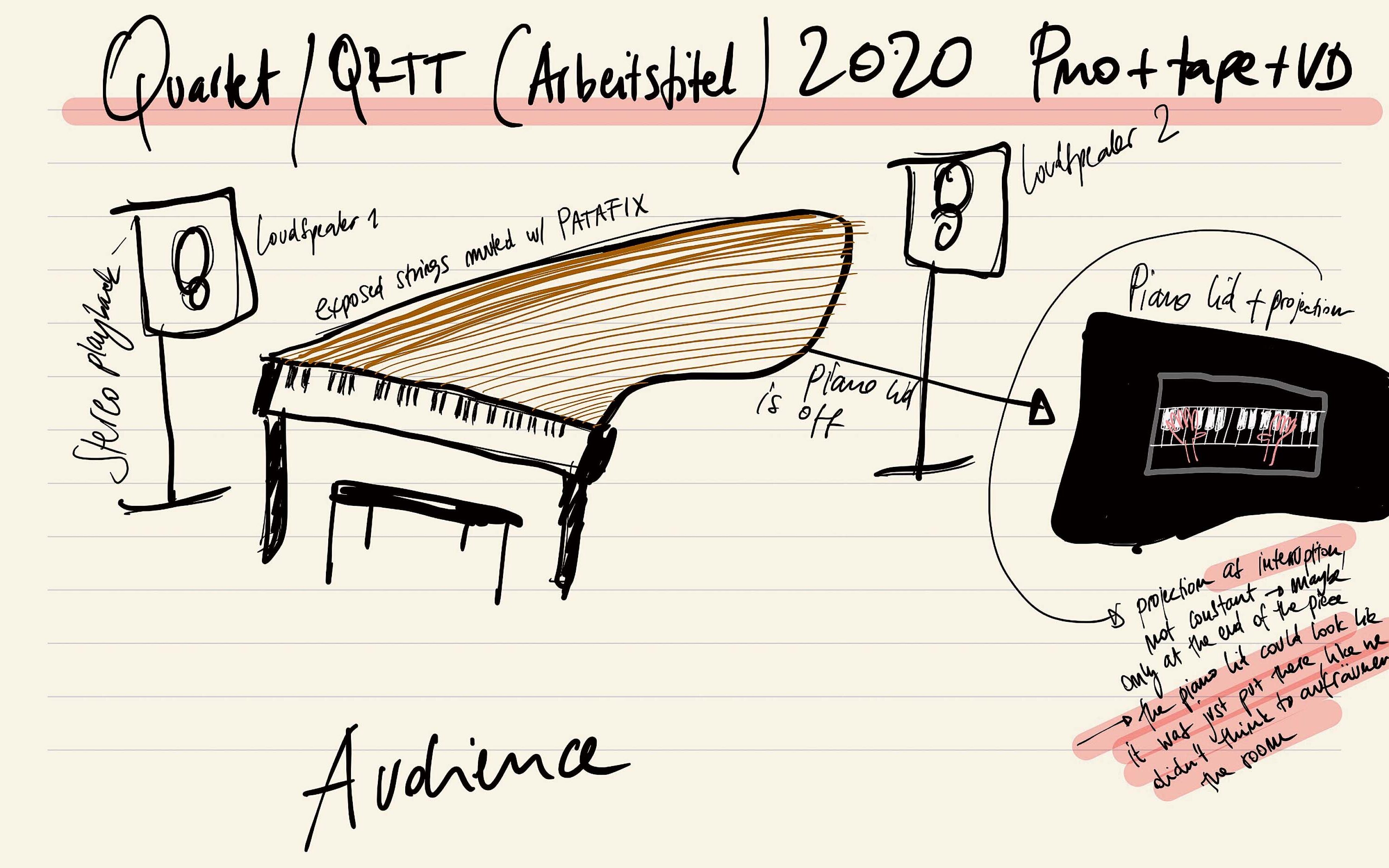
Sara Glojnarić, sketch for Latitudes for piano solo and video, 2021.

Herbert von Karajan, Note, 1955, archive of the Ernst von Siemens Music Foundation.

Catherine Lamb, sketch for two curves (for James Tenney), 2020.
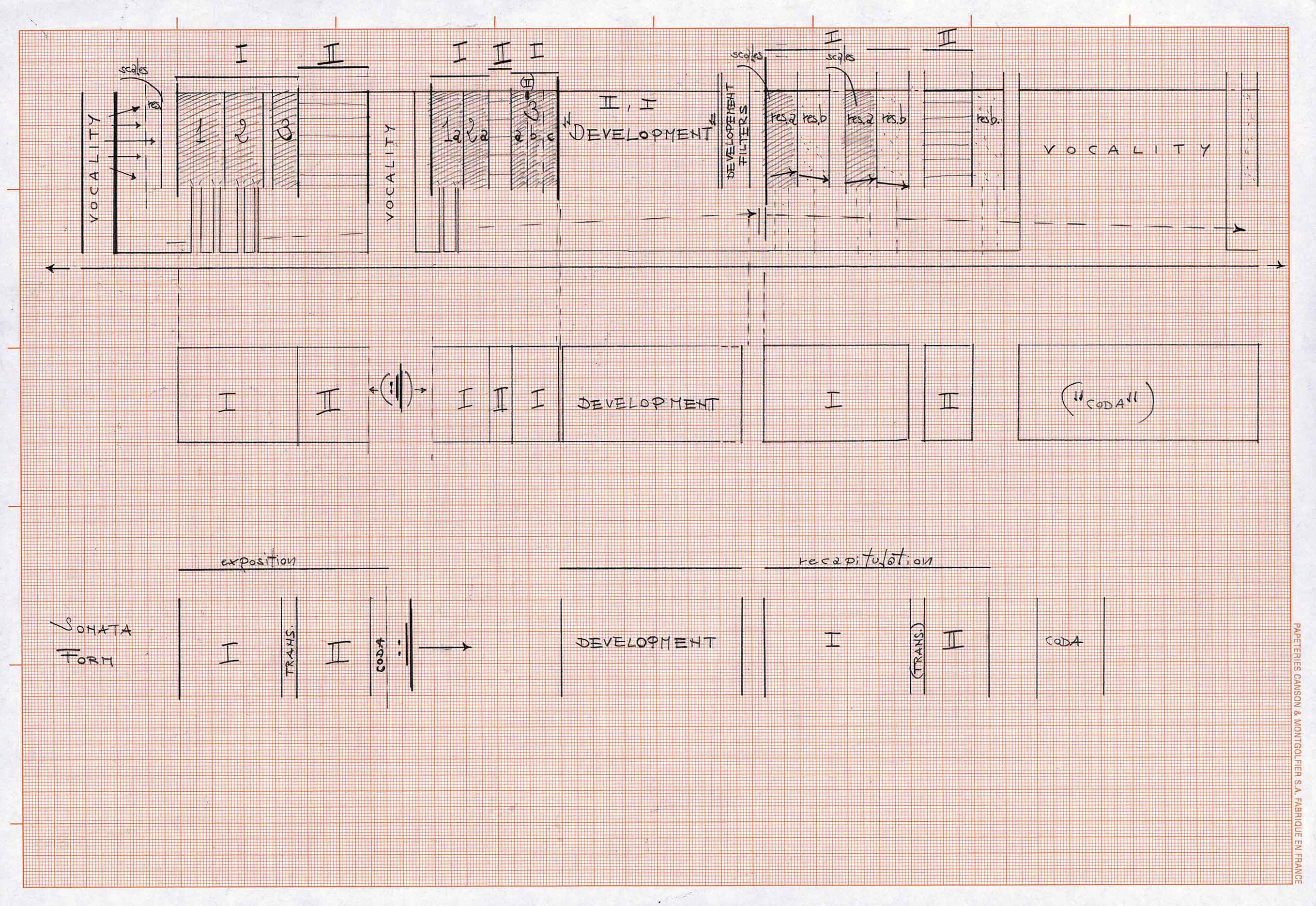
Simone Movio, structure sketch for Incanto IX, 2014/2015.

Charlotte Seither, La_gente I, No. 982, acrylic/ink on paper, 30×40 cm, 2021.

Ulrich Kreppein, sketch for Caligari, Opera/Musical theater, 2022.
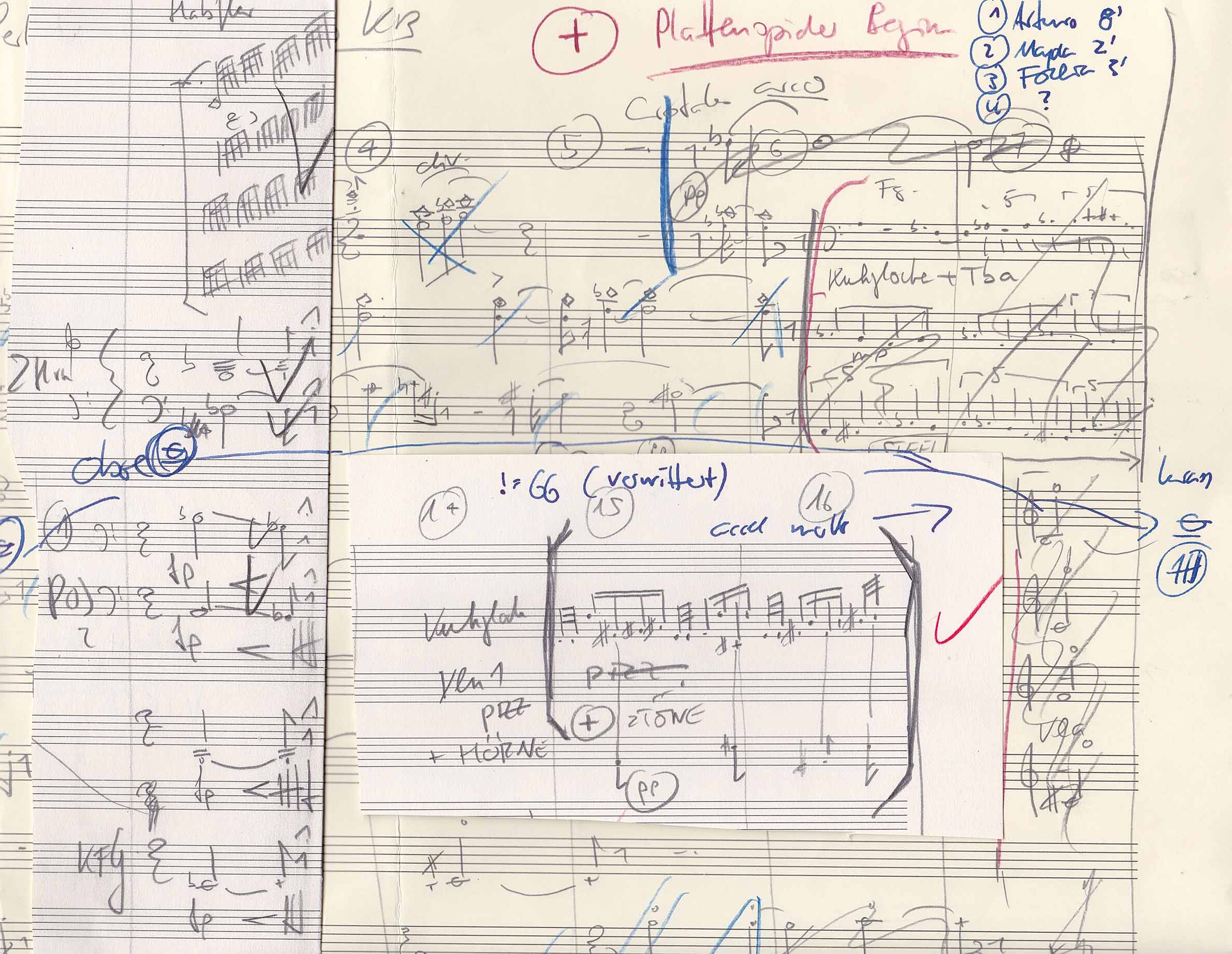
Gordon Kampe, sketch for Fat Finger Error for orchestra, 2018.
Ernst von Siemens Music Foundation Essay Series
Lydia Goehr, 2023 Music, Measure, Climate
I am converting the title that the American writer Ray Bradbury gave to his novel from 1953—Fahrenheit 451: America to Europe. Bradbury wanted to know the temperature at which paper burns. With different protocols, the measure would change with the paper’s thickness and weight. Exactitude, however, was less Bradbury’s point than the politics and prediction that shapes the writing of science fiction. Politics and prediction are two themes for my own essay: to write, that is, with warning
signs in and out of time.why prediction assumes an urgency under social conditions of climate change, where one sort of change regards technology, another the movement between academic scholarship and writing for the newspapers (as we see on the original cover of Bradbury’s novel)
1
 Fahrenheit 451 by Ray Bradbury
, and a third sort of change regards the paradigm for a mode of musical composition set into an unrestful social pattern of production and reception.
Fahrenheit 451 by Ray Bradbury
, and a third sort of change regards the paradigm for a mode of musical composition set into an unrestful social pattern of production and reception.
Bradbury described a world on fire: book-burnings, then people. He allowed books to become personified so that a loss of knowledge on paper became a loss for the memory and the mind. Bradbury was neither the first nor the last to invoke a world ablaze: a “bonfire of vanities” from Florence when thousands of human artifacts were destroyed in the public square, and then, centuries later, a short story from 1844 by Nathaniel Hawthorne, who brought the bonfire under the rubric of “earth’s holocaust.” Bradbury’s dystopian novel, written at a high temperature, envisaged a world of the future consumed by every sort of consumption: a world reported by the headlines and mottos of the daily newspaper. Writing the future was for Bradbury to write the present in the shadow of the past: to write, that is, with warning signs in and out of time.
Throughout his text, Bradbury threaded sound-lines of musical and unmusical thoughts. He ran the lines into earplugs so that persons, now wired to machines, could no longer take walks. (He would pen a separate short story about a pedestrian stopped on the street by the police just for walking.) His novel described an “amazing conductor playing all the symphonies of blazing and burning to bring down the tatters and charcoal ruins of history”— and then a suicidal woman named Mildred who was so consumed by “the singing of the thimble-wasps in her tamped-shut ears,” that she could not hear the sky screaming or the roar everywhere around of the machine age. Her “thimble-wasps” foretold a world silenced amidst all the noise—rather as today’s music critic for the New Yorker magazine, Alex Ross, brings twentieth-century classical music under the the rest that is noise. Bradbury felt the unrest all around: an unhappy domestic family surrounded by walls of no design, shadow, time: painted with the abstraction of the monochrome. A veritable world without qualities. Daily breakfasting to the humming of “electronic bees,” Mildred could only be viewed at a distance by her estranged husband, Guy Montag, who, as a fireman by trade, had daily to suffer the enormous percussion-concussion of the transport outside: the modern subway sucking everyone into its “gigantic vacuum,” its “great thunderstorm of sound,” its “pure cacophony.” Anthropomorphized as tiny creatures or insects,sound-lines of musical and unmusical thoughtsMildred’s earplugs concealed the electronic mechanism that threw words at the “phono-color walls.” Known also as the seashells from the Seashell Radio, the earplugs pounded people into submission through waves of magnetic sound. The electronic tracks similarly afforded Montag no protection from the rhythm of modern times beating out the evercompounding words of a world made for advertising: “Denham’s Dentifrice, Denham’s Dandy Dental Detergent.” Bradbury saw nowhere to walk anymore, let alone to run. The subway of his daily transport had become the modern means of moving people, of mobilizing “a million men.”
Rethinking his novel in later years, Bradbury recalled having tried to write “a story of prediction, describing a world that might evolve in four or five decades.” It turned out that there was no “might” about it. In Beverly Hills, California one evening, he saw a woman walking. At least she was walking—but only because she could hold in her hand “a small cigarette-package-sized radio”“a small cigarette-package-sized radio,” from which “sprang tiny copper wires which ended in a dainty cone plugged into her right ear.” With plugged ears, she, too (like Mildred), was oblivious to her surroundings. Bradbury saw a science fiction turned into social fact. He felt the urgency of passing time: “I must start writing very fast indeed about our future world in order to stand still.” Here was a subtle observation for a writer seeking a stopping place in a world construed by a fiction for the future. Futuristic fiction assumes a vantage point beyond the current measurements of science, beyond facts, but falls into contradiction when, under the rubric of science fiction, the facts catch up and take over.
It is early morning, October 25, 2022. I am sitting in Frankfurt am Main, in Germany, converting Fahrenheit to Celsius— America to Europe. An SOS appears on my computer screen instructing me to “follow all official directives during ongoing efforts to defuse a Second World War bomb” in a nearby town. I think back first to who might have dropped the bomb, and then to the war’s aftermath when the returning members of the Institute of Social Research refused to come to terms with the atomic age, with the age of technological reproducibility, with a society consumed by industries of the sort of capital invested in companies whose names, like Shell and Mobil, could well have given Bradbury the advertising terms for his novel. Frankfurt’s critical theorists, Theodor W. Adorno and Max Horkheimer, did not predict the future; they diagnosed the present to work through the past. Refusing to come to terms was not for them to sit still in subjection to a master discourse: it was to subject all the terms of precisely such a discourse to critique. To listen to the Master’s Voice was to question the mastery of a master.
The task assigned to me for this essay is to assess the climate changes in current musical institutions, practices, and paradigms of modern, classical music. My topic is the predictive art and work of the future brought to the electrical currents that keep thinking on the move. Recalling Adorno’s words on the “currents of music” that are still with us today, I find it worth reminding readers of all that it can mean to assess the current times against the currency of the economy as conveyed by currents electronically streaming to turn the currents of our daily bread to crumbs in the uneasy digestion of our thoughts. Asked to measure the changes of current times, I find my answer pitted at the extreme temperature of “everything and nothing” so that I can work through a range of examples of what up to today has gone on in all the rivers in between. What today, one might ask, is the mainstream am Main?
One is hard-pressed to find in the many social and cultural diagnoses offered today a critical approach to music that has so significantly changed the terms of critique provided so many decades ago. We read in current scholarship of the cross-crossing, crossover and hybridity of genres within and without music, of digital and post-digital platforms and formats, of recycling,recognition patching, multi-layering, assembling, and sampling. Music study has been significantly broadened by sound and noise studies. Advanced digital technologies have altered the economy of music’s distribution. Anthropological paradigms of an all-inclusive world-music have expanded the repertoire beyond recognition. But recognition is still a central term. Carrying an enormous baggage on our backs, we find one sort of recognition encouraging us to seek in our present a comforting continuity with the past, while a second sort of recognition demands that we use our cognitive framing of the present to re-cognize the past, so as to give it a relevance that feels up-to-date for us today. And then there is a middle or third form of recognition that again splits the “re” from the “cognition” to seek in the past what is different from the present, to challenge both the past and present frames.
With the complexity of recognition comes terms of acceptance and refusal, reconciliation and ongoing feelings of incompatibility. The fit and the lack of fit invests the hermeneutical task of writing music’s history with every tension of tense. When a contemporary musicologist “mediate as it is mediated by music.”like Georgiana Born explores through “digital anthropology new ways of conceptualizing the interrelations between the material and social, resisting any tendency either to collapse them or to treat them independently,” the resistance is still a call for a critical dialectic and a network of mediations: “For a political economy of the internet,” she writes, it must be shown to “mediate as it is mediated by music.” When another musicologist, Lena Dražić, describes the “Inclusions/Exclusions” in the “field of ’New Music’ in Europe and its boundaries,” she contrasts a current decentering of the field with the continuing center of a European middle that, since the 1960s, has had few qualms about condemning an expansion past the mainstream as a sign merely of cultural atrophy. Publishing their work in 2022, both these current musicologists use critical theory to follow the complex threads of what is moving music forward and backward, and how the movement between these two terms, as the critical theorists showed decades ago, does not automatically align with progress and regress. “Inclusions/Exclusions” in the “field of ’New Music’”
October 29, 2022, I visit the Goethe-Haus in Frankfurt, but only after taking a coffee in a cafe in the courtyard next door. Named Cafe Utopia
2
 Cafe Utopia, Frankfurt/Main
, it advertises in English its motto all around: THE FUTURE WAS BETTER IN THE PRESENT. I question the use of the past tense and check it against the German. What difference, I wonder, would it make were it to read THE FUTURE IS BETTER IN THE PRESENT. Are not dreams of the future always better in the present when the present is seen to be in crisis? And do we not overwhelmingly see our present in crisis? What if one said THE FUTURE WILL BE BETTER IN THE PRESENT—that just sounds willful, perhaps also too hopeful!? I return to the past to ask whether, in the Goethe-Zeit, the future was seen as better than it is envisaged today. Googling the Cafe, I learn that all the cafe’s coding of color, music, and food is meant to be a looking, or even an experiencing, back to the past. But wasn’t something in that past responsible for the crisis we feel now so urgently in the present? Deciding that now is the time to go look at those in the past who once looked forward, I enter the exhibition. The Goethe-Haus is most impressive for displaying the confidence of those around 1800 who proclaimed the beginning and end of Romanticism, the ideals of a classical age, with all their contributions to the sciences, to philosophy and the arts. One room takes us back to Beethoven, in part to remind us of the Beethoven paradigm that has preoccupied my own thinking for most of my life as a philosopher of music: how the “concert hall” came to dominate the commissioning, producing, making, distributing, and receiving of “classical music” for the next 200 years. And yet with a twist everywhere still evident: that “serious” music so-classified never entirely eschewed the lightness that, only when labeled alone for a “popular” music, so split the world into two false halves.
Cafe Utopia, Frankfurt/Main
, it advertises in English its motto all around: THE FUTURE WAS BETTER IN THE PRESENT. I question the use of the past tense and check it against the German. What difference, I wonder, would it make were it to read THE FUTURE IS BETTER IN THE PRESENT. Are not dreams of the future always better in the present when the present is seen to be in crisis? And do we not overwhelmingly see our present in crisis? What if one said THE FUTURE WILL BE BETTER IN THE PRESENT—that just sounds willful, perhaps also too hopeful!? I return to the past to ask whether, in the Goethe-Zeit, the future was seen as better than it is envisaged today. Googling the Cafe, I learn that all the cafe’s coding of color, music, and food is meant to be a looking, or even an experiencing, back to the past. But wasn’t something in that past responsible for the crisis we feel now so urgently in the present? Deciding that now is the time to go look at those in the past who once looked forward, I enter the exhibition. The Goethe-Haus is most impressive for displaying the confidence of those around 1800 who proclaimed the beginning and end of Romanticism, the ideals of a classical age, with all their contributions to the sciences, to philosophy and the arts. One room takes us back to Beethoven, in part to remind us of the Beethoven paradigm that has preoccupied my own thinking for most of my life as a philosopher of music: how the “concert hall” came to dominate the commissioning, producing, making, distributing, and receiving of “classical music” for the next 200 years. And yet with a twist everywhere still evident: that “serious” music so-classified never entirely eschewed the lightness that, only when labeled alone for a “popular” music, so split the world into two false halves.
THE FUTURE
IS BETTER
IN THE PRESENT
The same day, in the evening, I attend a production of Richard Strauss’s Capriccio, his last opera from 1941. The concept for this highly self-conscious Konversationsstück in one act is not subtle. But then the signs suggest that it is not meant to be. It turns the aristocratic Madeleine into a Parisian resistance fighter who, with her luggage ready-packed, conceals guns in violin cases and liberation posters, so that finally she can come out with a contrasting political sympathy against her wealthy background and the court-theater.DEM WAHREN, SCHOENEN, GUTEN. Her choice between music and words—in accordance with the late eighteenth-century debate about opera— becomes a choice between love, art, and action, theater and politics, domestic security and taking a stand. The production leaves it up to the audience to read the revisions of her choice into a libretto that uneasily wavers between high Wagnerian warnings and complicities about the making of a master’s art for the future in the context of war.
Walking home after the performance, I am struck by the contrast of the two opera halls in Frankfurt. First, the Alte Oper
3
 Alte Oper, Frankfurt
Zweites Opernhaus, Frankfurt
a reconstruction of the bombed-out house first erected in 1880 with its motto still standing proudly front and center: DEM WAHREN, SCHOENEN, GUTEN. Lit up, the facade has one billboard to the right advertising the American musical Cats while the left side advertises a range of musical offerings: a philharmonic concert, a jazz party, and a chamber music concert. The second opera hall is part of a theater complex designed in 1963. It is not named the new opera house
4
Alte Oper, Frankfurt
Zweites Opernhaus, Frankfurt
—perhaps to avoid any misconception of its offerings—not a theater for “new opera” but for a standard repertoire that, along with the old opera house, continues the Museumskonzerte first organized by the Frankfurter Gesellschaft in 1808. The foundation of a museum named for a society “devoted to the muses” and to the “fine arts of literature, visual art, and music” affords me a second opportunity to recall how I brought the Beethoven paradigm under the rubric of an “imaginary museum” to capture how the temporal and transitory art of music as a fine art of “the true, the good, and the beautiful” had constructed a work-concept for collecting its “objects” as one would the enduring plastic arts of sculpture and painting.
On this evening, however, I find myself thinking more about the Parisian notion of La Musée imaginaire, when, in 1947, Andre Malraux was envisaging the distribution of all the arts far extending any institution erected for the nation in a city of high capital. I realize in this moment that I could be in almost any city, or in no city at all. I think of the many contemporary theorists who have re-theorized the aesthetic and political imaginary so as to assess the strength and weakness of the walls that have so desperately tried to keep the master discourses and distinctions of fiction and fact, possibility and actuality, essence and appearance in place. As I walk further, I feel my mind trapped between the view of the city as a silent palimpsest with all its layers of remembering and forgetting and the view which, La Musée imaginaireso well strung along by the subway stops, parades the metropolis under the noisy pandemic of tourism. I recall from earlier in the evening the posters of liberation held up in the Strauss production against the foggy windows that framed the stage and then the flag-colored statement of support for the liberation of Ukraine in a war where the media coverage constantly harks back to a past rhetoric of liberating a nation from Nazism. Who’s who in the rhetorical alignment is as complex, I now realize, as stringing dates together—1808, 1941, 2022—to assert that the future is, was, or will be better in the present.
In 1970, at the Guggenheim Museum in New York, the American “minimalist” composer, Steve Reich, predicted music’s future.
Electronic music will gradually die and be absorbed into the ongoing music of people singing and playing instruments. Non-Western music in general and African, Indonesian, and Indian music in particular will serve as new structural models for Western musicians. Not as new models of sound. (That’s the old exoticism trip.) Those of us who love the sounds will hopefully just go and learn how to play these musics. Music schools will be resurrected through offering instruction in the practice and theory of all the world’s music. Young composer/performers will form all sorts of new ensembles growing out of one or several of the world’s musical traditions.
What Reich described as “the old exoticism trip” predated a current hope for a world-music premised on critical diversity as opposed to a blind devotion to “the other.” (Today, we rightly balk at thinking of the “non-Western other” merely in terms of “native informers.”) But then Reich far more conventionally hoped for a return to a harmonious unity of alienated parts. “Serious dancers,” he went on to say, “who now perform with pulseless music or with no music at all will be replaced by young musicians and dancers who will reunite rhythmic music and dance as a high art form.” And then further: “The pulse and the concept of a clear tonal center will reemerge as basic sources of new music.” His predictions were both right and wrong. Ignoring his references to what is “serious” and “high,” his almost blanket erasure of so much modern experimentation in music and dance stands out. Did he really mean to erase so much? Elsewhere, when assessing “Contemporary Music and Institutions,” he noted the restrictive training of orchestral musicians to a standard symphonic repertoire, with the result of their coming to the stage automatically loathe to play a new music that did not seem to fit or belong to the tradition. Seeming to see no possibility of retraining, Reich cast his “lot for the future” with the modern ensembles: France’s Ensemble Intercontemporain, Holland’s Schoenberg Ensemble, Germany’s Ensemble Modern, “The pulse and the concept of a clear tonal center will reemerge as basic sources of new music.”England’s London Sinfonietta, and Hungary’s Group 180. No mention of any ensemble in America!—only a praise for the decrease in numbers that led to an increase of responsibility: more solo work, he said, and less doubling up. He found a comfort with electronic music—the new music being “in their bones.” But a nagging question loomed over his optimism: whether symphony orchestras could survive if no “contemporary music” was composed for them. Or was it the reverse, as I wondered now: where precisely the absence of the “new” guarantees the orchestra’s survival!
November 28, 2010: Alex Ross asked in the UK’s The Guardian: Why do we hate modern classical music? From his first line, we sense a “me,” a guardian of new music, against the “we,” the discontented audiences who almost automatically “still gnash their teeth” at the works of the Second Viennese School (Arnold Schoenberg, Alban Berg, Anton Webern). Adding the term “still” suggests that surely enough time has passed for audiences to have accustomed themselves to a music composed a century ago. Ross describes the “new music” as an “unleashing of harsh chords,” or as an “ultraviolence” when referring to (the English composer) Harrison Birtwistle’s concertante Panic of 1995. Here, Ross does not clarify whether the descriptive terms accord with how angry audiences hear the music, how he hears it, or how the music should be heard. But consider that if a music is composed under the rubric of panic, wouldn’t a gnashing of teeth be fitting? Did not Lamentations allow the gnashing of teeth as a deep, biblical expression of a people’s suffering? Imagine an audience with faces all looking like Edward Munch’s 1893 screamer, or better, with ears covered,“unleashing of harsh chords” to suggest a return to the oldest unrest in the books as shown in the 1910 painting Dissonanz
5
 Dissonanz, 1910 by Franz von Stuck.
by Franz von Stuck.
Dissonanz, 1910 by Franz von Stuck.
by Franz von Stuck.
An Enlightenment doctrine and a mainstay of aesthetic theory reminds us that responding to an artwork demands a response both to its content or subject matter and to its form, so that even when titled Panic, the form may transform the ugly notes back to the beauty of Pan. But then a counter perspective suggests that it is high time to set aside the proverbial silence of the concert hall that has so prohibited all external and noisy expressions of pleasure and pain. Here is another sense of the “rest” that “is noise,” the noise that was removed so that a biblical silence could become a silent space for the silenced concert audiences of a “serious” music. Ross mentions his carrying a pocket- score to help him comprehend how the composition unfolds, but how he’s often tempted to use the same object to hit the noisy gnashers nearby on the head. I recall the rules of etiquette that I listed to open my Imaginary Museum of Musical Works. I know that I, too, am a husher of audiences even as I am often prone to gnash my own teeth. Once in New York, Ross and I watched an audience departing from a hall with a decidedly loud step. We wondered whether this was mere ignorance or, instead, a civil disobedience , perhaps given the presence of an emperor parading on the stage without clothes.
Ross asks after the hate of modern classical music to set aside its many explanations by a n entire range of critics, historians and neuroscientists. Brains, we learn from the literature, are not wired to hear dissonance without distraction; minds don’t want to work through so much pain for so few pleasures; persons attend concerts to forget all the panic outside. Ross compares the musical case with the other modern arts of painting, literature, and architecture, how high prices are paid for the “avant-garde”—to own a Pollock why we hateor a copy of Joyce’s Ulysses, or to commission a new building. But why not pay also for Schoenberg’s original scores— assuming that the value of property does not equal the value of experience? why we loveOne can own a Pollock without looking at it or a manuscript without reading it—although commissioning a building without then putting it to use tends to raise eyebrows because of the large, usually public expenditure. Turning art into a high rise of property accords with diagnoses of cultural consumption where audiences purchase tickets not to enjoy the offerings but to be seen at the events. Expensive tickets work like tourists’ souvenirs, to be taken home as enduring substitutes for passing appearances. Ross is both right and wrong to think that the case for and against classical music is a special case. But this is less pressing than his own diagnosis: that hate, after all, is not the problem, whereas love is. Too much liking of “classical music” has made anything different to it—the “modern”—automatically disliked. Ross’s question why we hate becomes a question why we love. The shift recalls what many have investigated as a borderline theological devotion: an aesthetic fidelity to past masters approaching the most dangerous political forms of idolatry and enthusiasm.
“If music be the food of love ….”
Ross quotes a critic from 1859 rejecting Brahms First Piano Concerto: “New works do not succeed in Leipzig.” Unlike Steve Reich, however, Ross does not turn to the “modern ensemble.” He rather seeks the release of the concert hall entirely from the “gilded cage,” as he describes it, so as to bring concerts “back to the world of the living.” He mentions the free beer and pizza now on offer to draw audiences in, but then the new guardianship that asks for musicians of an old and new music not just to perform but also to educate. He too leaves a question hanging for us: whether he really wants no more gnashing at all, or whether, instead, he would like a more critical gnashing given a new menu demanding a different sort of digestion of the thoughts. “If music be the food of love ….” will “the rest” still be “noise”?
The journalist and music critic, Tim Rutherford-Johnson, closes his 2017 Music after the Fall: Modern Composition and Culture since 1989 with predictions that have been premised on “revolutions” in the development as much of “classical music” as of “technology.” He notes “the image problem” that since the 1970s has found “new music” overly separated by both promoters and detractors: a separatist aesthetic for a separatist audience despite all counter movements toward integration and continuity. Yet he finds that so many different paths have been taken that to offer a single narrative or path promoted for the present and future would belie the exciting diversity that, “after the Fall,” spreads its wings over “the whole ecosystem.” For Rutherford-Johnson, to find the image problem in the 1970s is not for him to deny its currency in prior decades, decades that already brought the case for and against new music into a world constantly upstaged but also fascinated by the very idea of change. Here, I offer some more examples of prediction to add to his own, and especially those that sustain a skewed sort of motto for the twentieth century: SCHOENBERG PLUS TECHNOLOGY WAS BETTER IN THE PRESENT. I, too, begin in the 1970s, after which I move backward in time.
will “the rest” still be “noise”?
Addressing in 1971 “The Crisis in Western Music and the Human Roots of Art,” the philosopher F.G. Asenjo began: “Music is at a crossroads. At no other time in history has there been a greater choice of musical languages and a more extreme disorientation.” He recalled having found in the 1950s a peak of saturation, when composers just couldn’t take tonality anymore. He then went on to describe an epidemic of unrest, of dogmatic prejudices, when musicians staked out their positions with no concessions. Above all, he aimed to remind readers of the exemplary aesthetic doctrine that had held sway for so long: that a musical composition should be judged not first by its methodical compliance to principle or rule but according to the aesthetic experience it affords. If it was worth listening to, as working or not working as a composition, its form, coherence, or Zusammenhang would be worth analyzing according to a compositional method. Turning to creativity and invention as “the roots of art,” he looked at Western music and then far beyond to non-Western musics to release what needed most to be released: the experience of all and any art from the evermore gilded cages of (academic) doctrine and dogma.
Speaking to the Incorporated Society of Musicians on “The Future of Music” in 1935, the English composer George Dyson similarly claimed to have lived through “one of the most remarkable revolutions in artistic history.” But for him, it was not now a revolution against “tonality,” but a technological revolution, where unless persons learned how to adapt, they would be replaced by machines. Adaptability and the continuation of “societies” for learning and practice, he argued, was how not to diminish but to expand human possibility, how to surpass machines that could compute but not invent. What or who, he asked, would copy in the future: would humanity come to mimic the machine (as though it had never done so before)? Would the machine become more a who than a what? He was clearly bringing the question of musical agency to the urgent matter of life and death: the life and death of a “human” form of life threatened by the positivistic science embodied in the (soulless) machine.
In 1926, assessing “Broadcasting and the Future of Music,” the first compiler for The Oxford Companion to Music, Percy Scholes, took a different tack. He noted the extraordinary advantages of a technology that could separate the eye from ear so as to bring music both to the blind and to the disabled. Would the machine become more a who than a what?Preempting the likes of Glenn Gould, he saw in the new recordings the possibility of a cultivation of listening that would lead audiences to applaud not the celebrity in view but the musician in performance. He saw “cheap pocket sets” and a “visual wireless” setting music free from the posture of sitting in one place. If listening kept apace, he added, new forms of harmony and orchestration would evolve in part to suit the new technology.
Adrian Boult
6
 Adrian Boult
, the well-known British conductor, decided to diagnose “The Orchestral Problem of the Future,” in 1934. From Monteverdi to Mahler, he saw a solid orchestra being overtaken by a new “extravagance” of instrumentation in number and kind. He picked on Schoenberg’s Gurrelieder of 1911 to note the addition to all the strings and winds of the “glockenspiel, xylophone, gong, rattle, and several large iron chains.” He perceived a selfsacrificial pointlessness in composing a music that would unlikely ever be performed (well), but noted the life support when Schoenberg’s scores started to sell “to Americans and other travelers,” at worst for coffee-table evidence of Bildung but at best for viewing and studying the new “masterpieces of music printing.” If the extravagance of orchestration was to be tamed or disciplined, orchestras, he insisted, would need more time for rehearsal and preparation. Preparation turned out to be Boult’s primary theme. With public and not only private rehearsals, the future, as he saw it, would witness orchestras offering audiences a guidance or guardianship in how compositions were put together. And that was better, in his view, than presenting works as always-already prepared products. Ambitious programming needed time and time was money: and generous public subsidy was clearly part of the solution.
Adrian Boult
, the well-known British conductor, decided to diagnose “The Orchestral Problem of the Future,” in 1934. From Monteverdi to Mahler, he saw a solid orchestra being overtaken by a new “extravagance” of instrumentation in number and kind. He picked on Schoenberg’s Gurrelieder of 1911 to note the addition to all the strings and winds of the “glockenspiel, xylophone, gong, rattle, and several large iron chains.” He perceived a selfsacrificial pointlessness in composing a music that would unlikely ever be performed (well), but noted the life support when Schoenberg’s scores started to sell “to Americans and other travelers,” at worst for coffee-table evidence of Bildung but at best for viewing and studying the new “masterpieces of music printing.” If the extravagance of orchestration was to be tamed or disciplined, orchestras, he insisted, would need more time for rehearsal and preparation. Preparation turned out to be Boult’s primary theme. With public and not only private rehearsals, the future, as he saw it, would witness orchestras offering audiences a guidance or guardianship in how compositions were put together. And that was better, in his view, than presenting works as always-already prepared products. Ambitious programming needed time and time was money: and generous public subsidy was clearly part of the solution.
Attacking Schoenberg as though he alone stood for the modern “image problem” of “modern music” would inspire many to his defense. Even for Boult, mocking Schoenberg paved a path to demanding conditions of rehearsal for performing the new music well—however extravagant the instrumentation. Two years later, in 1936, the bibliophile and first American chairperson of musicology, Richard S. Hill, wrote an article titled “Schoenberg’s Tone-Rows and the Tonal System of the Future.” He immediately declared the “twelve-tone system” as “no arbitrary freak.” “Arbitrariness” and “artificiality” were age-old “put down” terms of abuse. Hill knew this and accordingly wrote of the tone-row system as having arrived “as the rational answer” to what the Scottish composer Cecil Grey in 1924 had already described as music’s “determined search after increased plasticity and expressiveness.” As such, Hill continued, (Schoenberg’s) system would prove in the long run according to music’s “growth … best [to] suit … future generations.” Taking up the issue of “harshness,” Hill recalled Schoenberg’s remarks on the temporary prohibition of certain consonant combinations until the time was right for their return.
With their return, new works, as opposed to old works, would emerge with hitherto unheard forms of consonant and dissonant harmony. What was key for Hill was that he already sensed in Schoenberg’s works what that return would be: a future musicality evident a future musicality evident in the compositions as latent possibility.in the compositions as latent possibility. He described this sense of the “not-yet” as in evidence every time the composer departed from the tone row or departed from the strict demands of the method. As with Asenjo later, Hill urged a listening to and an analysis of the subtle “departures that, even if temporarily prohibited by theory, were already there in the “practical experiments in composition.”
In the 1950s, the Austrian-born exile in England, Hans Keller, chided those who, on chronological grounds, equated the new with the modern with the contemporary. “Something is evidently wrong with history,” he quipped, “and almost everything is wrong with chronology.” He described generational quarrels and abuses in translation, as when the Austrian Internationale Gesellschaft für Neue Musik (IGNM), founded in 1922, became the ISCM—International Society for Contemporary Music. He saw in the contest of terms a victory only of mediocrity, an arbitrary mixing and matching to produce a “third-hand Stravinsky.” Why third and not second? Like so many critics of his time, the Stravinsky versus Schoenberg versus Richard Strauss contrasts supplied the moving targets for an agonistic musical criticism designed usually to condemn less the masters than the overly devoted disciples.
Finally: confronted in 1914 with the general “bewilderment” at the new music, M.-D. Calvocoressi proposed an almost Freudian analysis of the evident unease, estrangement, and alienation. He noted Ernest Newman’s having just written for the Musical Times of Schoenberg’s Five Orchestral Pieces:this sense of the “not-yet”
It is too late in the day to call Schoenberg either a madman or a conscious charlatan. We now have too much fine music from his pen to be able to doubt that he has one of the finest musical heads of our day. And that alone, undoubtedly, is an argument which suffices to carry conviction, and to induce us to study with zeal and sympathy even the most recondite and unattractive music that he has given us.
Here, over a century ago, was an instruction for gnashing audiences not to reject out of hand what did not automatically accord with their expectations, but to turn, as Calvocoressi did, to the new music with an open mind. “flying against tradition“Assessing the theory and the practice of the new music, Calvocoressi claimed to find nothing that would testify to a “current conception” of the composer (Schoenberg) as a “musical anarchist or mountebank,” an “enemy of form, style, and proportion,” or as “flying against tradition,” or as “striving to build a monument to ugliness and confusion.” But what purpose in pointing all this out if one found “current conceptions” persisting despite, or was it because of, all the evidence to the contrary. This question of persistent belief remains key for us today, defining as in every past age, the general pandemic of “public opinion.”
It is now November 14, 2022 and I read a report by Harriet Sherwood, a correspondent for The Guardian, of how the “future of opera” as decreed by the Arts Council in England is to move away from the “lavish (read expensive) productions in grand venues” to be re-situated in “car parks, pubs and on tablets.” Funding is to reach a ground zero for the English National Opera. Far from “sounding a death knell,” the Arts Council envisages a “bright, if different, future” for the opera far outside of London, the capital city. Raising the issue of “metrophobia” is one point; the temporary or permanent loss of employment for London-based musicians is another. But both play to the broader issue as to whether, if there is to be a continued audience for opera, the productions must accommodate what interests the “new” (read “young”) generation today: a sense of art made public and possible in car parks, pubs, and on portable tablets. Everyone is aware of how the recent pandemic inspired a new technological creativity, Puccini’s La Bohème in the car park. In the car park, so we are told, opera becomes less intimidating and more nurturing of “artists of African and Asian heritage.” So that the whole move may be branded as a healthy “shock of the new.” Something needs to be modified in the still rather patronizing discourse of insiders and outsiders: a discourse that seems to presuppose that outsiders (artists of “other” heritages) can never feel comfortable inside. Take away the inside and the outside goes too. But what we are left with is what we have already had for so long: La Musee imaginaire. Removing the opera outside of London is another Brexit crudely premised on overly-hardened cuts carved into the current currents of music’s mainstream production.
All the terms, names, and dates carry an enormous baggage of anxieties evident everywhere in contemporary discourses. Temperatures are rising beyond the measure at which paper burns. Many speak of the end of prediction, the end of history, the end of grand narrativesTemperatures are rising beyond the measure at which paper burns.—not to close down the future but to open it up. TV series, like Mozart in the Jungle, offend the jungle by assuming animals to be like humans in the capital cities. But battering humans is part of the problem quite as much as it is part of the cure. Many say the problem of modern music is far less urgent than the problem of all music. But by what standard when the wealth and poverty of YouTube promises a music-made-global?
So I go finally to YouTube to seek changes in a “classical” music still written for the orchestra and ensemble. I find mostly programmatic or, better, atmospheric or cosmic titles about nature and time The womb is pregnant with possibility, extending far beyond the supply and demand for works fitting the old imaginary museum.or titles that draw the works’ meanings back to the first pipes and lyres of antiquity. There are few “untitled” titles of refusal as dominated in the 1960s and 70s, and far fewer “absolute” convictions that once rendered sufficient a titular specification only of genre and number: Symphony no. 5. But not all the contemporary works jibe with the forecasts that rain down for a post-new-musicology that is demanding that new voices be heard with all the abandon and abundance of new labels of technology. Georgiana Born closes her survey of music and digital media North, South, East, and West with a long list of labels for a new sound age, for a new eco-system, for a new planetary anthropology: from “DIGITALes, Alien8, … [to] the Gauche, Finite State Machine and the unlicensed WOMB.” The womb is pregnant with possibility, extending far beyond the supply and demand for works fitting the old imaginary museum. Born ends where I have always ended my own books, between the All and the Nothing, so that everything of meaning comes through the highly heated examples in between.
I return in my mind to the Cafe Utopia to realize that, in focusing on the tenses of time, I forgot to question the optimism supplied by the middle term. Suppose the motto had read: THE FUTURE WAS WORSE IN THE PRESENT. Would I have drunk a cup of coffee under the banner of such seeming doom? Words have purchasing power: they sell and sell out the goods. Better or Worse; Dead or Alive: posters today point as paintings once pointed with eyes of conscience and correction to follow us all around.
Lydia Goehr
is Professor of Philosophy at Columbia University. She is the author of many books on philosophy, music, and critical social theory including The Imaginary Museum of Musical Works: An Essay in the Philosophy of Music and most recently Red Sea-Red Square-Red Thread. A Philosophical Detective Story.